
In every contact center, performance is driven by habits more than dashboards. Metrics like NPS, FCR and queue health improve when teams execute the right behaviors consistently and with intention. Yet many organizations focus heavily on analytics while ignoring the daily actions that actually move these metrics.
If you want long-term operational improvement, not a short spike that disappears in a week, the key is to establish habits that compound over time. The following three habits are the most effective for improving customer experience, operational stability and overall contact center performance. These practices are used across top nearshore call centers, outsourced customer support teams and high-performing BPO operations.
1. Daily Micro-Coaching: The Most Effective Habit for Improving FCR
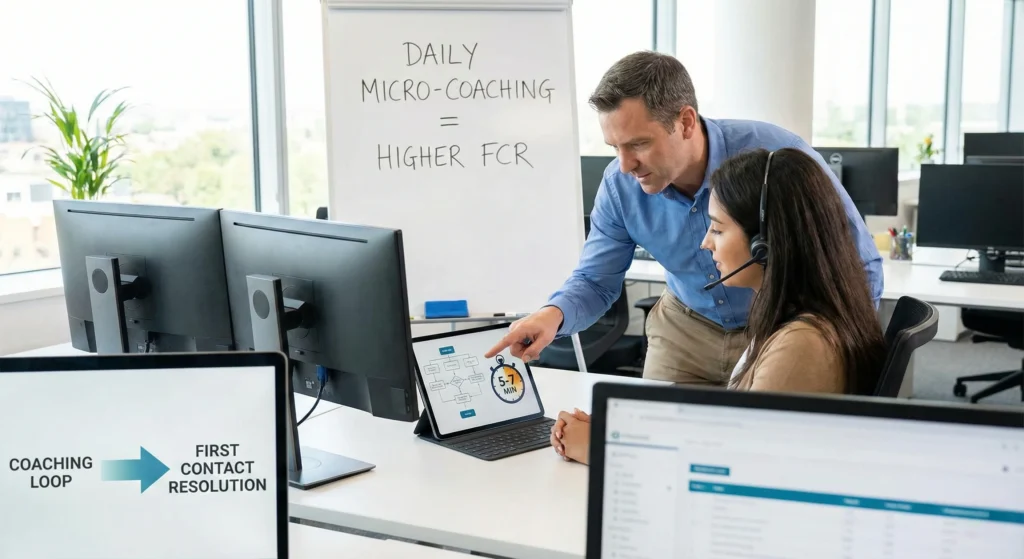
First Contact Resolution typically drops when agents lack clarity, confidence or alignment with your product or processes. Micro-coaching solves this quickly.
Micro-coaching refers to short, focused coaching sessions of 5 to 7 minutes completed daily. These sessions create a continuous improvement loop that keeps agents aligned with customer expectations, updated product information and the behaviors needed to resolve issues correctly on the first attempt.
Why this habit improves FCR:
- Mistakes are corrected before they become patterns
- Product knowledge remains fresh
- Agents build confidence resolving issues without transferring or escalating
- Repeated customer contacts and long interaction chains are reduced
Organizations that adopt structured micro-coaching usually see measurable FCR improvements within 3 to 6 weeks because the feedback cycle becomes immediate instead of delayed.
This habit is especially powerful for outsourced technical support teams and high-volume customer service environments where every unnecessary touch increases operational cost.
2. Pre-Shift Alignment: The Habit That Stabilizes Queue Health

Queue health becomes inconsistent when teams start the day without clarity. A simple five-minute pre-shift alignment creates structure and eliminates unnecessary chaos.
This meeting provides:
- Clear daily priorities
- Expected volume forecasts
- Channel-specific coverage needs
- Reinforcement of goals for AHT, adherence and customer satisfaction
Instead of responding to issues as they appear, the team begins the day aligned and ready. This significantly reduces abandoned calls, improves service levels and keeps queue distribution more predictable throughout the shift.
This habit supports the core elements of queue health:
- Faster average speed of answer
- Better control of AHT
- Consistent SLA achievement
- Improved workload distribution across voice, chat, email and back office
No technology can compensate for a team that starts the day out of sync. This simple but high-impact habit is used across leading Dominican Republic call centers and nearshore BPO providers because it creates immediate operational stability.
3. Post-Interaction Reflection: The Habit That Improves NPS
NPS rises when agents consistently deliver clarity, empathy and ownership across every interaction. These qualities come from reflection, not memorization.
This simple habit strengthens emotional intelligence and decision-making, both of which directly influence NPS. Over time, agents naturally adopt better interaction patterns that lead to:
- Stronger customer rapport
- Increased trust
- Higher satisfaction with resolutions
- A higher likelihood of customer recommendation

Across the industry, this is one of the most reliable habits for improving NPS without increasing AHT or training costs.
Why These Habits Work Together
Each habit strengthens a different core element of contact center performance:
- Micro-coaching strengthens accuracy and confidence
- Pre-shift alignment stabilizes operations and queue flow
- Post-interaction reflection enhances customer sentiment and quality
Together, they improve:
- NPS
- FCR
- AHT
- Queue health
- Agent performance
- Customer satisfaction
- Operational consistency
Dashboards track results.
Habits create them.
Looking to Improve NPS, FCR or Queue Health Quickly and Sustainably?
At ISC Intelligent Solutions, we help companies in the United States scale their customer experience with high-performing outsourced customer support teams, outsourced sales specialists, technical support operations, chat teams and back office services.
Our nearshore call center operations in the Dominican Republic provide bilingual agents, industry expertise and measurable performance improvements.
If you are looking for a reliable outsourcing partner that understands metrics, optimization and customer experience at a professional level, we can help you strengthen your operation and reduce costs without compromising quality.
Contact us today to explore nearshore CX solutions designed for performance.